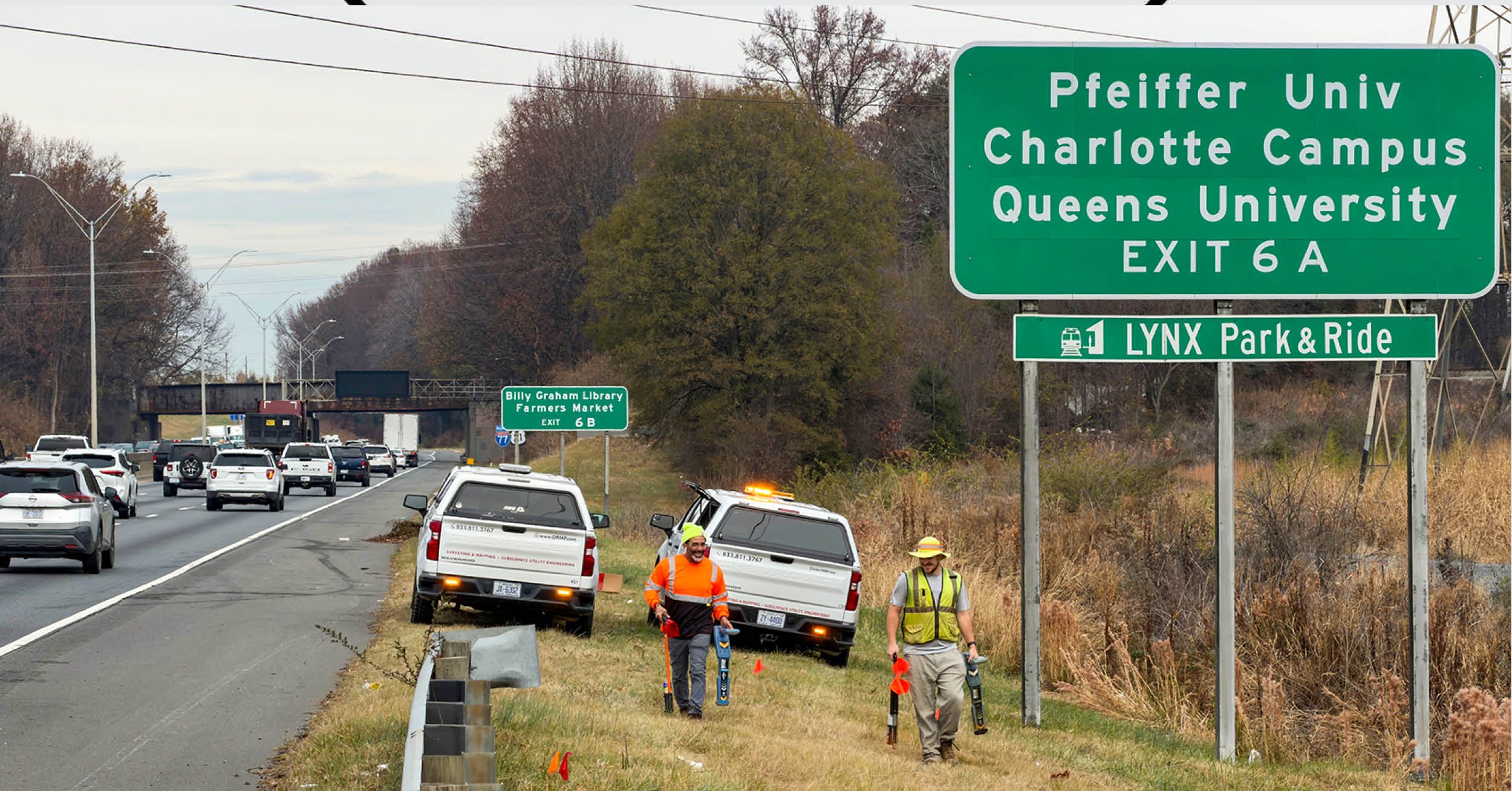
Few corridors in North Carolina challenge a survey and subsurface utility engineering (SUE) team the way the southern stretch of Interstate 77 through Charlotte does. I’ve worked in dense urban highway environments before, but this one stands apart. According to the North Carolina Department of Transportation (NCDOT), this segment has a crash rate more than twice the statewide average for urban interstates, making it one of the most crash-prone highway sections in the state. It also serves as a critical link for commuters and freight moving between the Carolinas, where daily traffic routinely exceeds capacity during peak periods.
When NCDOT selected DRMP to provide survey and SUE services for the I-77 South Express Lanes project, we were stepping into the largest undertaking our North Carolina survey and SUE teams had ever taken on. The project will add two new express toll lanes in each direction, reconstruct key interchanges and bridges, and introduce direct connectors to improve access and traffic flow along an 11-mile corridor. With an estimated cost between $3.2 billion and $3.7 billion, delivered as a public-private partnership with NCDOT contributing about $600 million, the project is already advancing through design surveys, SUE mapping, and environmental and planning reviews. Construction is anticipated to begin about 2030.
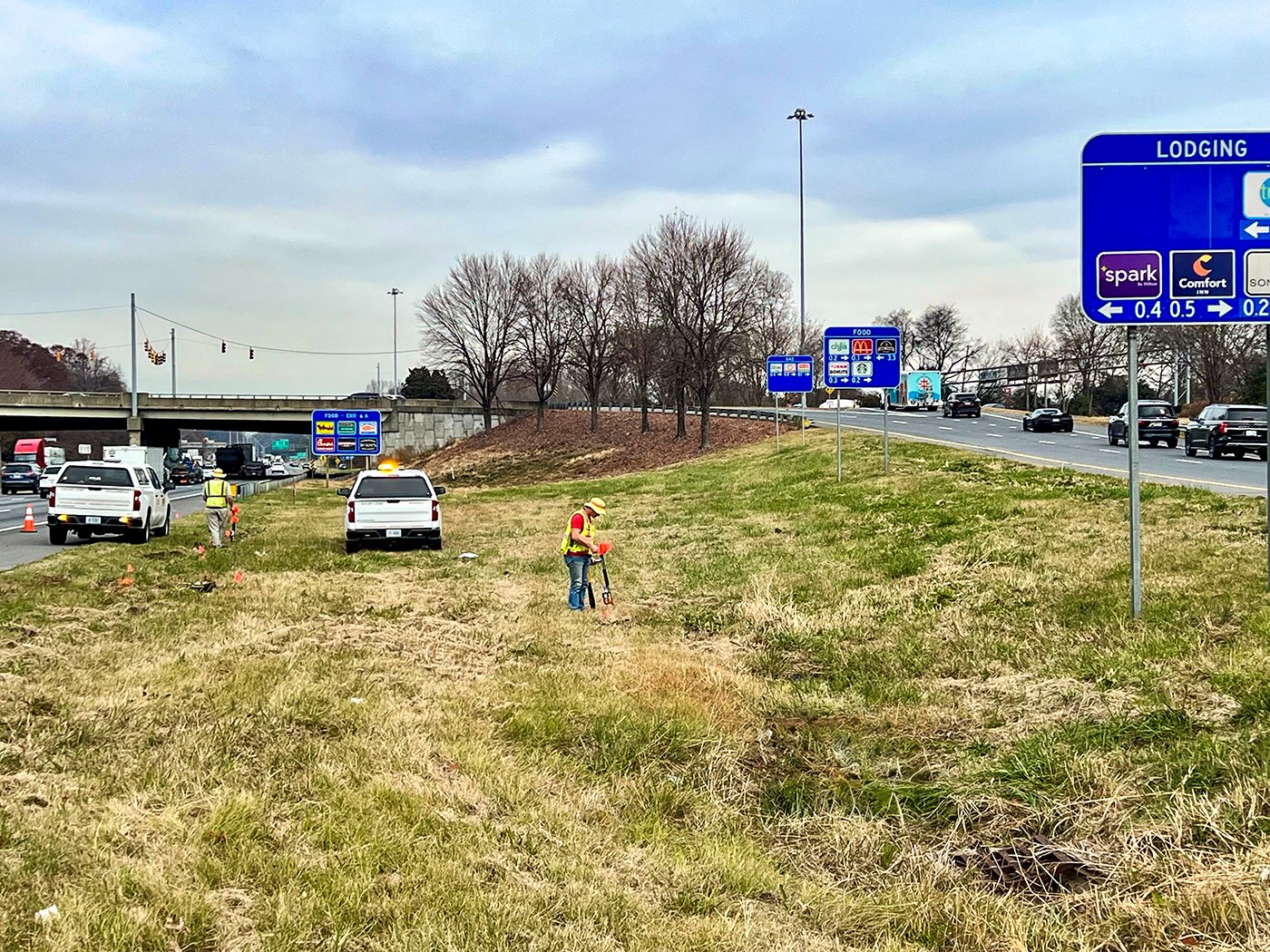
Under DRMP’s on-call location and surveys contract with NCDOT, my team is responsible for Section 2, a 3.7-mile middle portion extending from 2,000 feet south of Nations Ford Road to Pressley Road. The segment is a vital connector between major interchanges, and its complexity is reflected in the survey limits, which extend beyond the interstate to include more than 1,300 acres and 400 properties, along with ramps, greenways, adjacent parcels and dense utility corridors.
NCDOT’s aggressive schedule requires real-time responsiveness, and our survey and SUE teams adjust field crews frequently, coordinate constantly with multiple stakeholders, and integrate new data streams quickly. Managing such a large volume of survey and SUE work with high accuracy reflects our team’s technical capability, adaptability, and commitment to delivering consistent results under pressure.
The survey and SUE data we collect is foundational for the project’s planning, engineering and construction. Topographic surveys define ground conditions, roadway geometry, and infrastructure locations needed to design new lanes, interchanges, and direct connectors. Property boundaries and right-of-way information guide acquisition needs and ensure compliance with state requirements. Accuracy at this phase is essential because it establishes the foundation for all work that follows.
Field Challenges Across a Contained Corridor
This project tests every aspect of mapping and surveying. The corridor’s dense urban setting, heavy traffic volumes, complex interchanges, and extensive underground utilities create one of the most challenging environments we work in. Identifying existing conditions, resolving utility conflicts, and ensuring reliable information for design and construction are critical responsibilities for our crews.
To collect high-accuracy survey data efficiently and safely, our field crews rely on real-time kinematic (RTK) GPS and robotic total stations, even in areas with limited satellite visibility. Standardized field procedures and centralized data management ensure consistency across multiple survey and SUE crews operating simultaneously along the corridor. Daily quality assurance and quality control (QA/QC) reviews verify accuracy and completeness before data moves to the design teams.
Designating and Mapping Underground Utilities
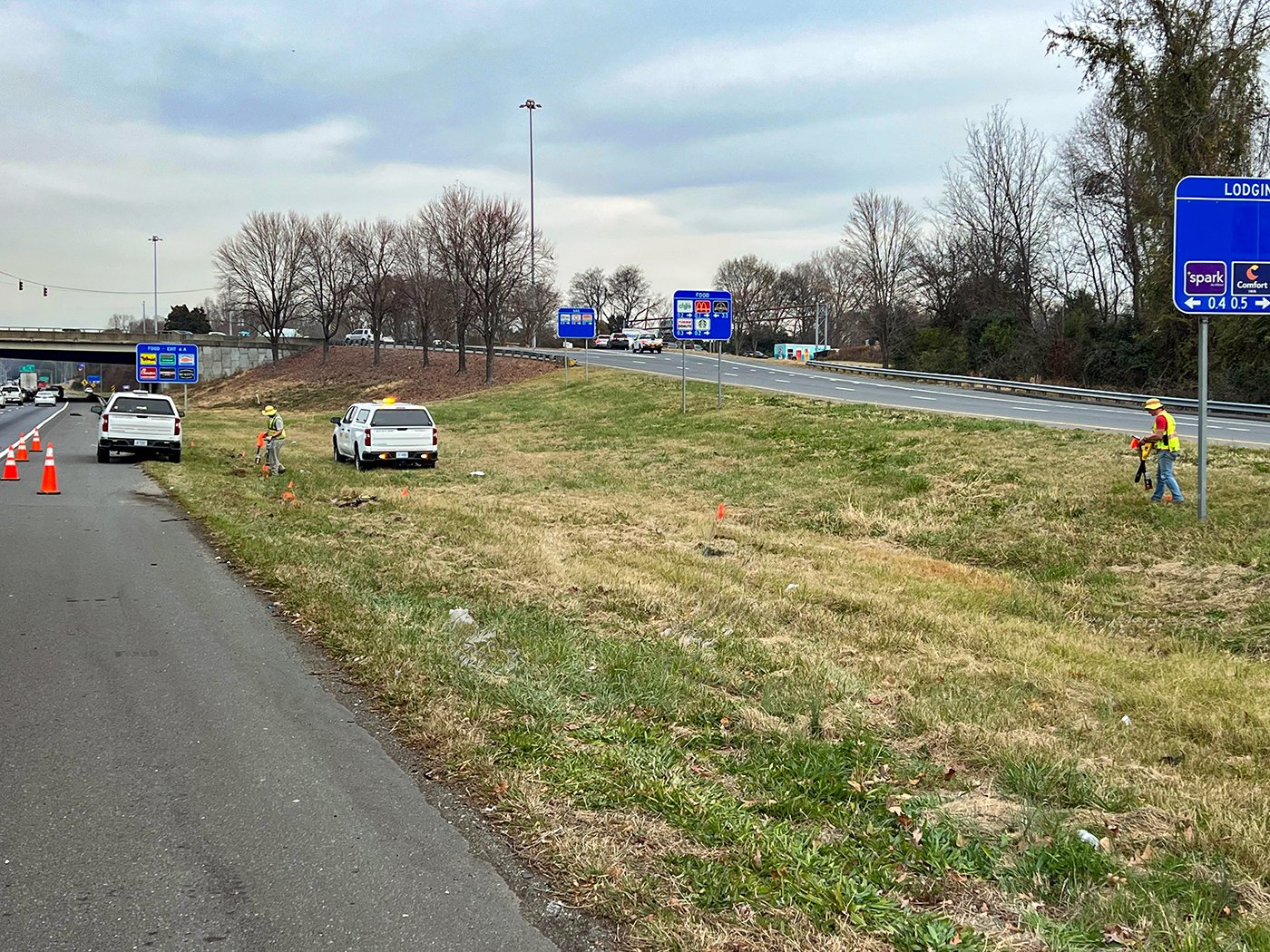
Designating and mapping more than 700,000 linear feet of underground utilities for more than 20 utility owners requires extensive coordination and technical precision. We begin by collecting existing records – plans, GIS datasets, and as-built drawings – from each utility owner. These sources provide valuable background information but rarely deliver the precision required for engineering and construction.
Our experts then perform Quality Level B (QL-B) utility designation using electromagnetic locators and ground-penetrating radar. QL-B, as defined in the American Society of Civil Engineers’ (ASCE) SUE guidelines, determines the horizontal position of buried utilities from surface indicators and geophysical methods without excavation. After designating utilities in the field, crews survey the markings using RTK GPS or robotic total stations and upload the results daily for review. Coordination with utility owners continues throughout the process to verify data, resolve discrepancies, and plan for future relocations or adjustments.
Ensuring Data Accuracy and Consistency
In this corridor, GPS signal obstruction is routine, especially near bridges and tall structures. When satellite visibility drops, our crews switch to robotic total stations, which provide millimeter-level accuracy using measured angles and distances. For property corners and critical structures, we conduct multiple observations at different times and with varying satellite conditions to ensure repeatability and minimize error.
All field data undergoes internal QA/QC review, cross-checked against benchmarks and control points that meet or exceed NCDOT standards. This level of scrutiny ensures that the data is reliable enough to support precise design and construction decisions.
Project Coordination
A project of this scale requires close coordination. Multiple DRMP survey and SUE crews work simultaneously along the corridor, making consistent field practices essential. Centralized data management, daily data uploads, and regular team meetings maintain alignment and prevent discrepancies.
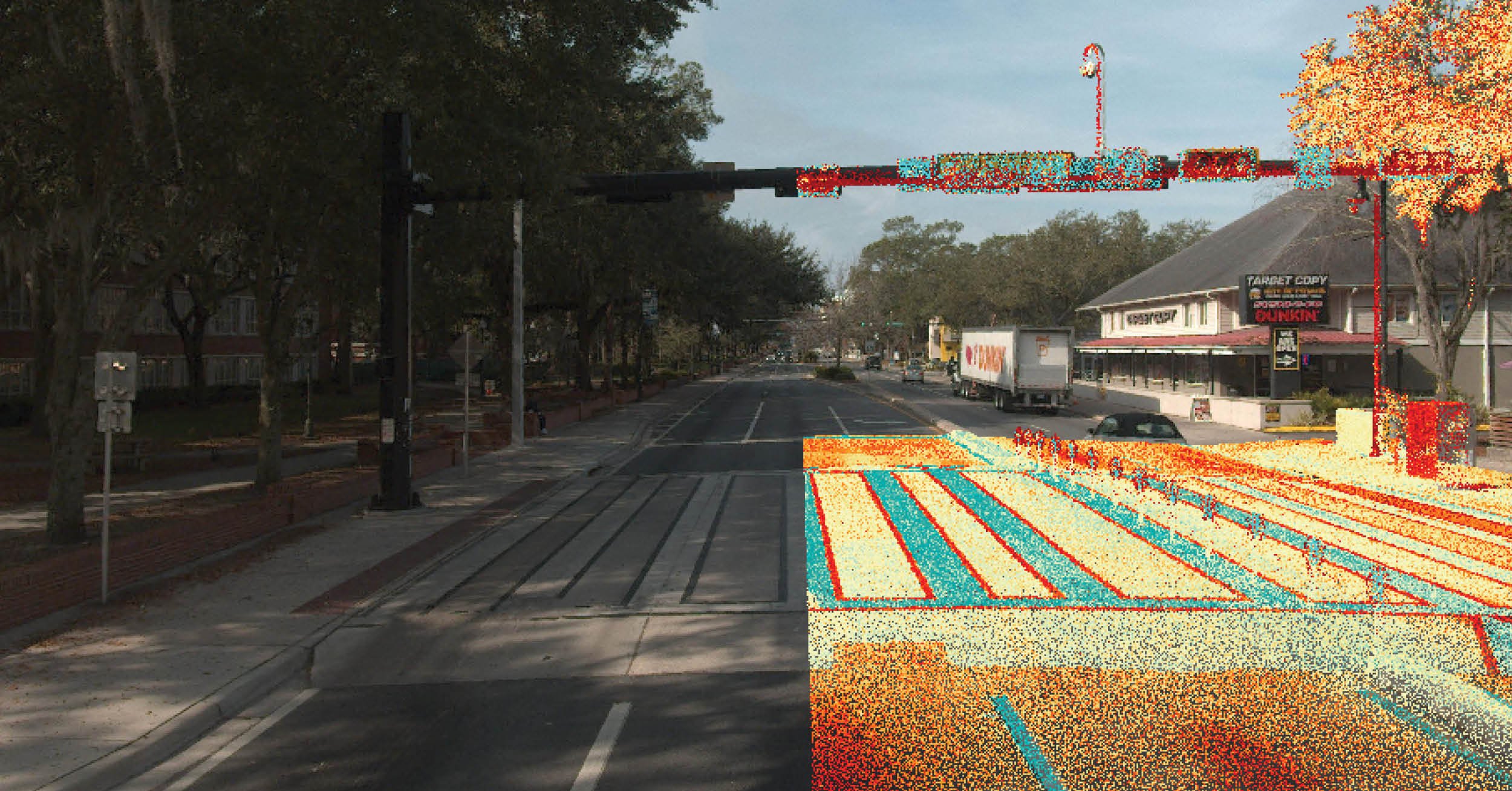
Externally, we collaborate with the firms responsible for adjacent sections and with the LiDAR scanning team. Together, we verify horizontal and vertical datums, coordinate tie-in locations, confirm coverage limits, exchange datasets, and conduct joint field reviews. These efforts ensure compatibility between terrestrial and aerial mapping and maintain consistency across the entire 11-mile project.
As work continues along the corridor, our survey and SUE teams remain focused on delivering precise, dependable data that will help provide a safer, more efficient I-77 for drivers.
August A. Thick II, PLS, serves as a Vice President and the North Carolina Survey Division Leader for DRMP’s Survey and Mapping/Geospatial Market Sector.