When a bridge or roadway project is planned, the surrounding development raises important questions: Which parcels will be affected? Who owns them? How will construction impact property lines? Traditionally, answering these questions meant accessing multiple state websites to get this information, downloading mismatched files, and spending hours – or sometimes days – to assemble accurate parcel data.
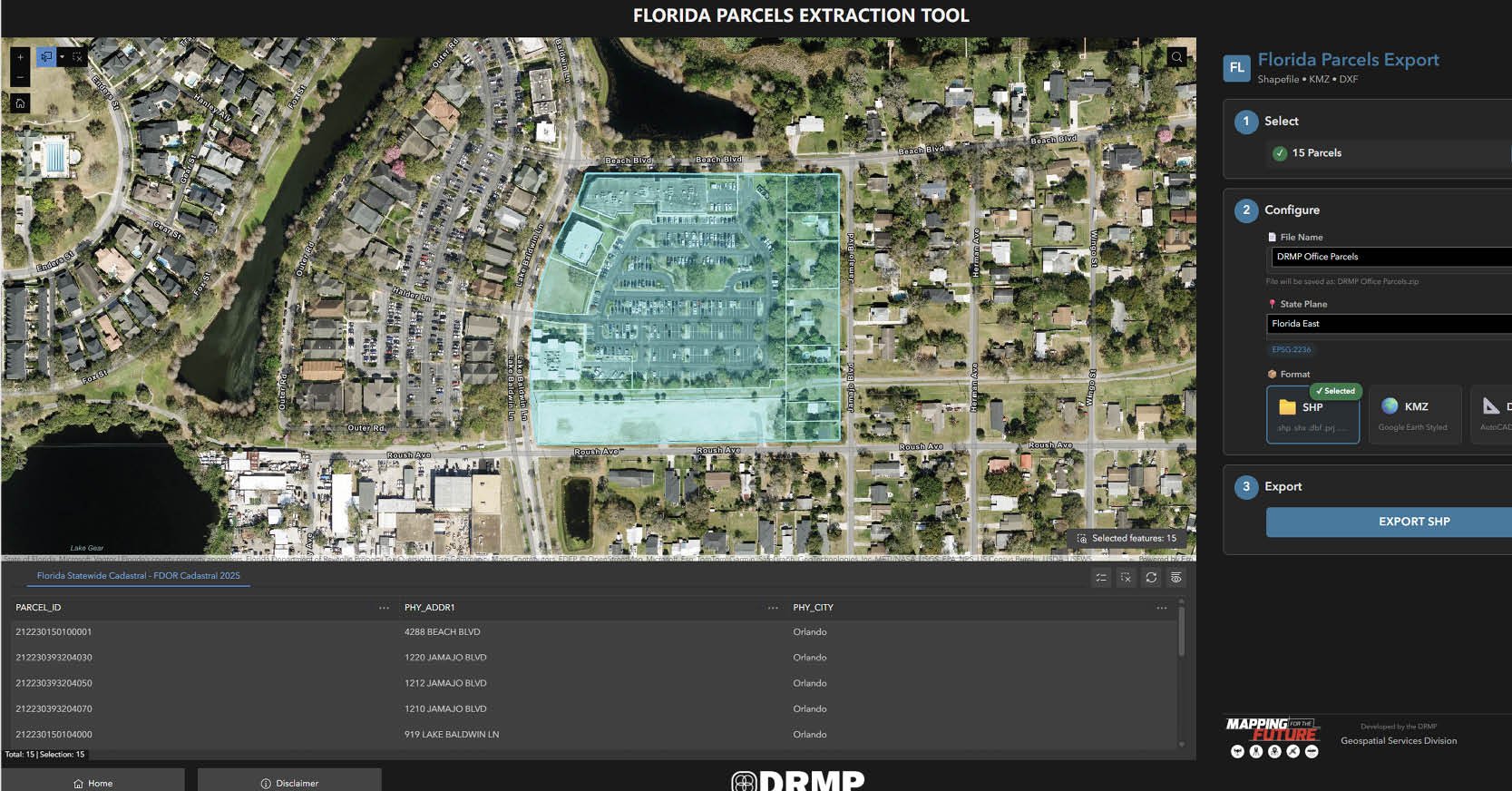
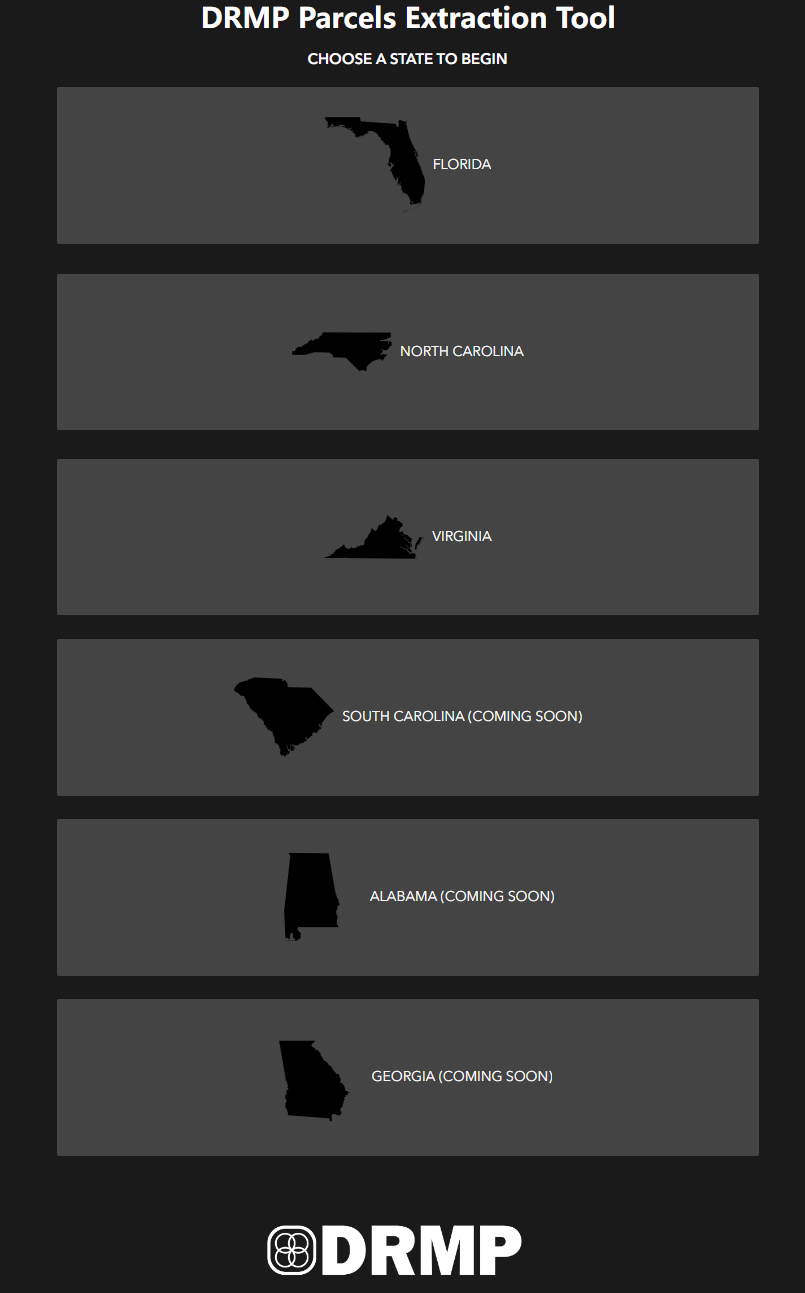
To streamline this process, DRMP’s Geospatial Services Division developed the Parcels Extraction Tool, an internal application designed to simplify access to parcel data in multiple states where DRMP operates, including Florida, North Carolina, and Virginia, with plans to add additional states. With just a few clicks, users can select parcels and instantly view ownership details, parcel ID numbers, and addresses. The tool also enables visualization of affected areas in 3D after the data is downloaded and exported to KMZ, Shapefile, or DXF formats.
An Innovative Solution
The idea for this tool came from Brent Bass, PE, PSM, a DRMP vice president and geospatial services division manager, and our Geographic Information Systems (GIS) team was responsible for developing it. Brent envisioned a tool that would allow users to access parcel data for any county all in one place in just a few clicks.
Many planners, surveyors, engineers, and environmental specialists have difficulty accessing parcel data in multiple formats and on various state systems. Survey and environmental design workflows often produce different outputs, which adds complexity.
With the Parcels Extraction Tool, users can quickly select only the parcels they need, name the output file, export the data in multiple formats, and use maps that keep measurements and distances accurate. The tool also lets users zoom anywhere on the map without needing coordinates.
For example, when planning a roadway project, our team can easily identify which parcels will be affected and evaluate right-of-way impacts, allowing for more precise decisions that help reduce project delays and costs.
The tool is innovative not just in functionality but also in design. While DRMP usually relies on standard ESRI widgets, our GIS team customized out-of-the-box ESRI widgets to make the tool functional, user-friendly, and intuitive. After multiple iterations, the tool was refined so that complex parcel selection and visualization could be executed faster and easier.
The tool is primarily used by all disciplines for land information, planning, and surveying. Almost every department at DRMP needs some type of parcel information. Within days of the tool’s release, daily users increased from 25–50 to 50–100. Our survey teams are among the most active users.
Simplifying Parcel Data
Before this tool, gathering parcel data was a manual, time-consuming process. Users often had to visit county property appraiser or department of revenue (DOR) websites, search for parcels individually, and then reformat the data for use in their projects.
For projects in Florida, the tool connects directly to publicly available statewide data, providing access to more than 10 million parcels. Although the state publishes this information in standardized formats, those formats do not always align with engineering and design workflows.
Similar challenges exist in other states. In North Carolina, parcel data is available through NC OneMap, while in Virginia, it is provided by the Virginia Department of Emergency Management (VDEM). In each case, the data is accurate, but it often requires reformatting before it can be used effectively.
DRMP’s tool addresses this gap by connecting directly to public data services, including those delivered through a Representational State Transfer Application Programming Interface (REST API). A REST API allows software systems to request and exchange data automatically over the internet, eliminating the need for manual downloads or navigation using multiple platforms.
By consuming data from these sources and converting it into the required format, the tool delivers ready-to-use outputs. This reduces the need for multiple software steps and significantly improves efficiency from data collection to project execution.
As projects grow in scale and complexity, DRMP plans to expand the tool’s capabilities to support additional states and accommodate a wider range of data formats as needed. This continued development will help streamline workflows and ensure our teams can access and use parcel data more efficiently for projects. To learn more about our GIS services, click here.
Ravneet Kathuria serves as a GIS Analyst for DRMP's Surveying and Mapping/Geospatial Division.