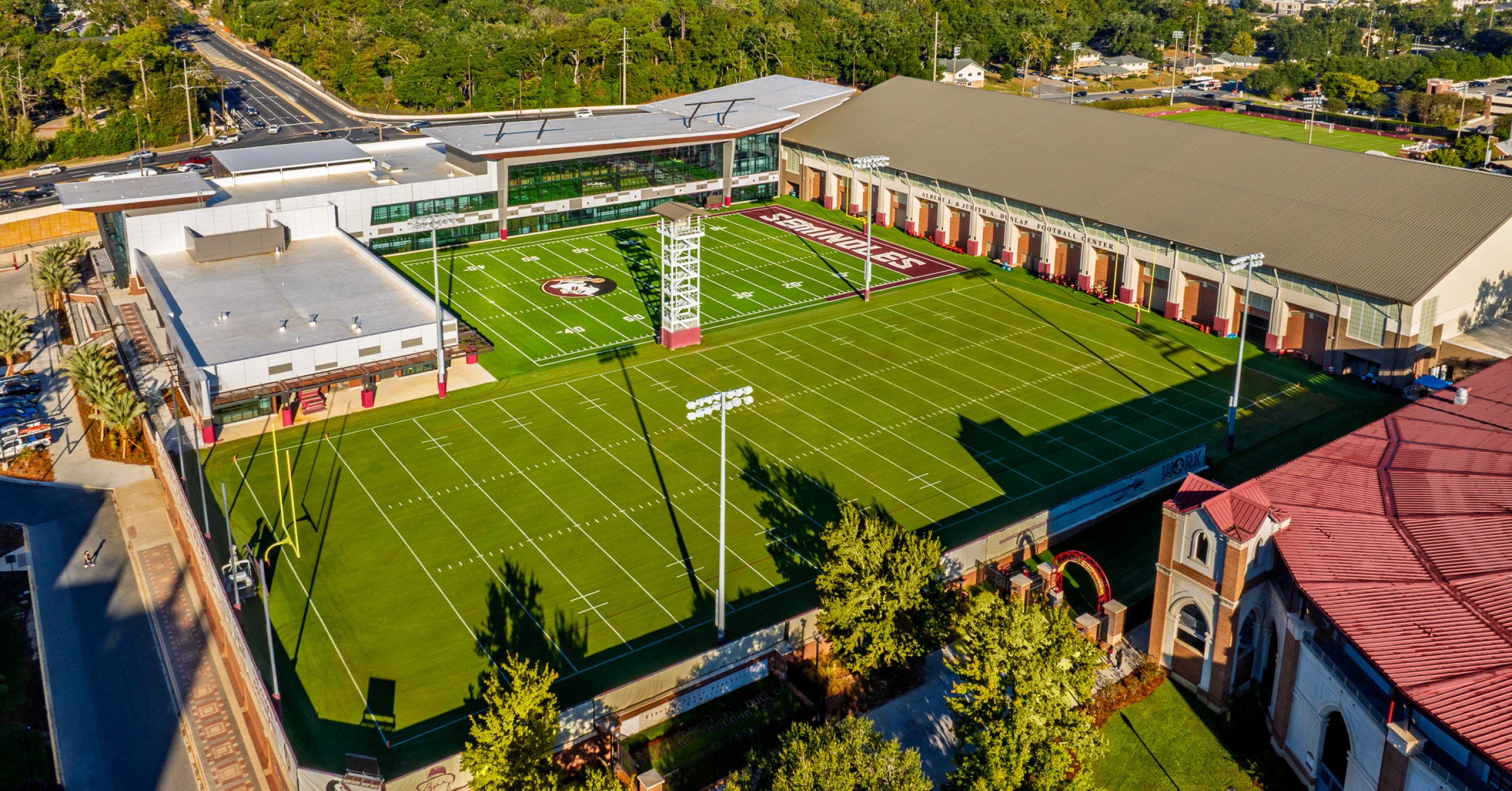
When your job is designing infrastructure, it’s not every day you get to help deliver a state-of-the-art athletic facility for a powerhouse football program. But that’s exactly what we’ve been fortunate to do at DRMP, working behind the scenes on Florida State University’s (FSU) $138 million Dunlap Football Center, which opened during the 2025-2026 football season.
Our Civil Services team was involved from the beginning, supporting Populous, the project’s architect, as a site civil subconsultant. We provided stormwater management, utility connections, grading, and designed the pedestrian circulation system, guiding foot traffic from the north and west side of the site into campus. Our work enhances safety by creating clear, accessible pedestrian routes that minimize vehicle interaction. The FSU Dunlap Football Center is a significant investment in the university’s athletics, and we’re proud to have helped design a space that supports and excites players, coaches, students, and fans.
A Hub for FSU Football
Located next to the existing indoor practice facility and the football practice fields, the new standalone 150,000 square-foot facility is designed to support FSU football athletes and staff with key features, such as position-specific meeting rooms, an indoor walk-through field, advanced strength and conditioning spaces, and dedicated areas for recovery, nutrition, and performance development. It also includes coaches’ offices, a recruitment lounge, and space for team operations and events.
The new facility enabled the entire football operation to move out of the older Coyle E. Moore Athletic Center and into a space built for how modern college football programs train, prepare, and compete.
Civil Work, Complex Challenges
Delivering a facility of this scale meant navigating a host of behind-the-scenes infrastructure and site challenges.
The site sits immediately adjacent to Stadium Drive North, a major four-lane state road with turn lanes maintained by the Florida Department of Transportation (FDOT). Although our work did not technically cross into the FDOT right-of-way, the proximity of the project’s structural work, including retaining wall systems and pedestrian paths, required the need for a rarely used construction agreement. We leveraged our strong relationship with FDOT District 3 to facilitate discussions with FSU, Populous, Whiting-Turner (contractor), and Catalyst (owner representative).
The west side of the site, which abuts Stadium Drive, posed unique challenges due to existing infrastructure including fiber optic lines, electric utilities, and traffic signal poles. Designing and constructing a new ADA-compliant sidewalk and switchback system required threading the needle around these elements without disturbing them. In addition, we had to address a 25-foot elevation change between the roadway and campus. The final design includes a continuous pedestrian connection that did not previously exist, providing safer, more direct access for pedestrians and cyclists.
Shoring Wall Innovation
One of the most innovative solutions on this project was the construction of a permanent shoring wall along the west edge of the site. Approximately 750 feet in length, this wall was designed not only to protect the new facility but also to safeguard the adjacent FDOT retaining wall. Some of the shoring piles had to be driven deeper than others, depending on the wall height and site conditions. This wall essentially acts as a buffer, permanently separating the building from Stadium Drive. Even if the current building is removed in the future, the shoring wall will remain, providing ongoing protection and allowing future development up to its edge without impacting the roadway.
By carefully sequencing construction around sensitive infrastructure, coordinating with state agencies, and engineering long-term protections into the site, DRMP was able to deliver a highly functional facility while also strengthening the university’s footprint for years.
Collaborative Teamwork
This project required close collaboration with FSU, Seminole Boosters, the City of Tallahassee, FDOT, the structural team from Walter P. Moore’s Tampa office, and more than a dozen subconsultants.
We coordinated everything from chilled water lines and electrical duct banks to stormwater runoff and ADA ramps. We worked hand in hand with the contractor to ensure little to no disruption was made to nearby facilities, such as the women’s soccer and softball complexes, Dick Howser Stadium (FSU baseball), and Doak S. Campbell Stadium (FSU football) to the south.
A Safer, Smarter Connection
From a civil perspective, one of the most rewarding parts of this project is what it does for everyday users of the campus. The new sidewalk and tunnel access finally gives pedestrians (students, fans, athletes) a safe, direct route through one of the busiest parts of FSU’s athletic district.
There’s one less crossing over traffic, a more connected walking path between facilities, and a safer route for campus events, such as annual races that pass through the area.
We’re proud of what we’ve helped create with the FSU Dunlap Football Center. It’s a modern, complex project that pushed every team involved to think ahead, collaborate constantly, and deliver something that works from the ground up. And for us? That’s the kind of project worth doing – truly a touchdown in teamwork and innovation.
Charles Redding III, PE, serves as a Senior Northwest Florida Business Development Manager for DRMP’s Civil Services Market Sector.
Randall Jernigan serves as a Project Manager for DRMP’s Civil Services Market Sector.