In 1991, the Environmental Protection Agency (EPA) issued a regulation to control lead and copper in drinking water. This regulation is known as the Lead and Copper Rule (also referred to as the LCR). Since 1991, the LCR has undergone various revisions. In October 2024, the EPA issued a final rule requiring drinking water systems across the country to identify and replace lead pipes within 10 years, a step aimed at making America’s drinking water safer and cleaner for all consumers.
The updated rule strengthens initiatives to identify existing lead pipes, recognizing that pinpointing their locations is essential for ensuring their replacement is both effective and fair. By October 2024, regulated water systems are required to complete initial inventories of their lead service lines with ongoing updates mandated under the LCR Improvements (LCRI).
One of the major challenges of the LCRI – besides cost –is identifying the pipes to efficiently replace them. Many cities have reported uncertainty about the materials used in their pipes due to a lack of information in their records from years past.
DRMP’s Subsurface Utility Engineering (SUE) experts are ready and able to assist with pipe location and inspection to help clients meet the 10-year deadline. Under the new rule, initial pipe inventories were due October 2024.
The EPA estimates that up to 9 million homes may have lead pipes across the country, many of which are in lower-income urban communities. The EPA also announced that $2.6 billion in funding from the Bipartisan Infrastructure Law will help cities replace their pipes. The new regulation also introduces stricter standards than those proposed last fall, which lower the allowable lead concentration from 15 to 10 parts per billion—a threshold water systems must now uphold.
Lead Pipe Inspection and Location Work
DRMP just completed two phases of pipe location and inspection for the Jacksonville Electric Authority (JEA), the eighth-largest community-owned electric utility in the United States and the largest one in Florida. JEA serves more than 1 million Northeast Florida residents with electric, water, sewer and reclaimed water services, in and around Jacksonville.
CDM Smith is the prime consultant for JEA, and DRMP is supporting the project as a subconsultant to Four Waters Engineering, a woman-owned Disadvantaged Business Enterprise (DBE). DBE status helps create more equitable opportunities for minority business owners to compete for state-funded contracts. Agencies that partner with DBEs also benefit from special incentives, and one of JEA’s key initiatives is to ensure that 20 percent of its consultants are DBEs.
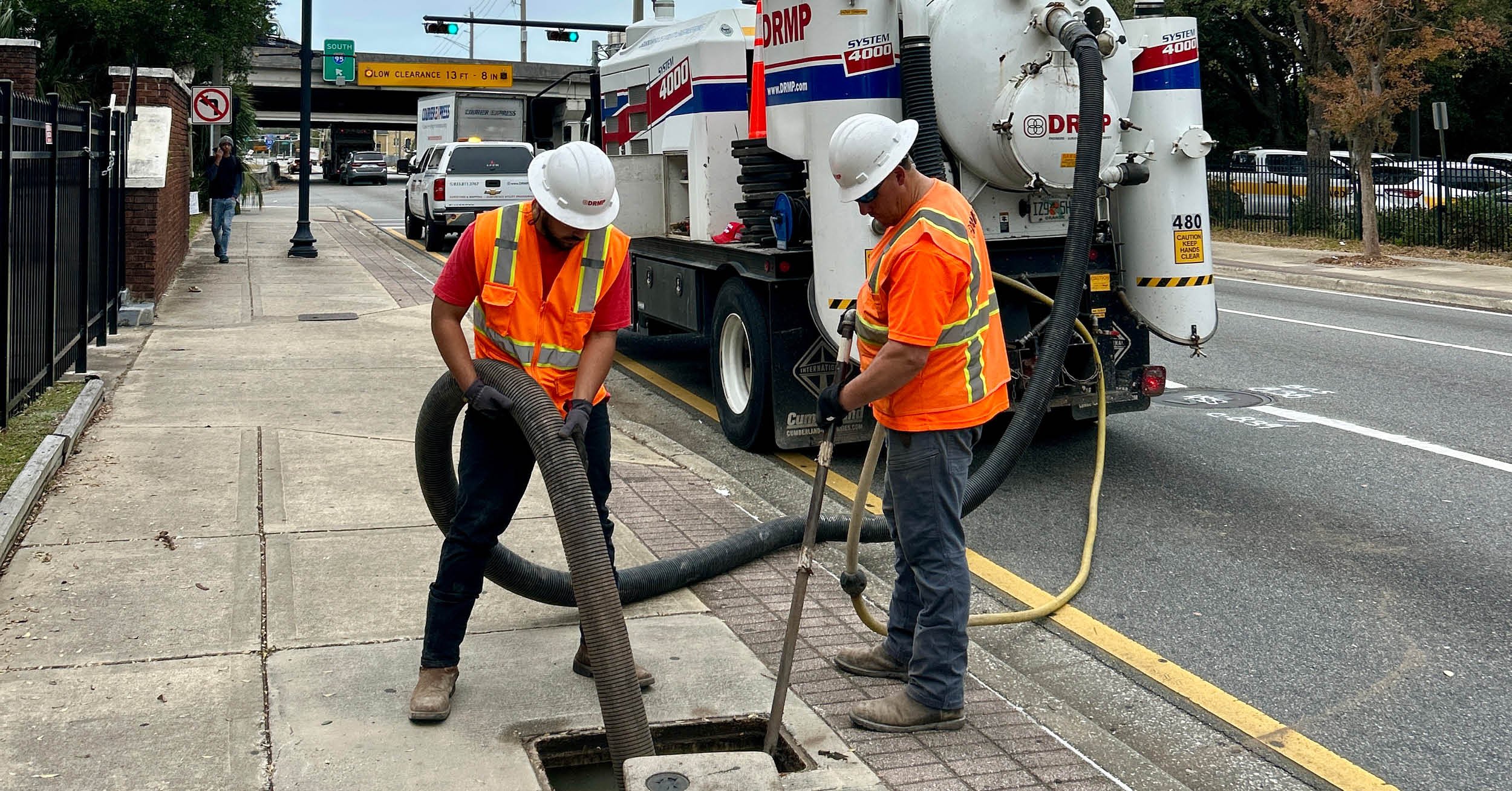
While our firm is not technically performing actual SUE work for these projects because it’s just an inspection, we're being called on for our expertise in vacuum excavation and non-destructive utility test holes.
For the JEA project, the first phase kicked off in May and consisted of locating and inspecting pipes for 400 random properties based on their age and available records that matched the project’s criteria. The United States banned the use of lead pipes in drinking water in 1986, so we’re focusing on properties built prior to 1986.
During Phase 1, we conducted 800 test holes to identify the materials used in potable water service lines. Typically, the meters for these properties are located within the right-of-way, just in front of private properties. At each meter, we trace the service line for a short distance in each direction and then excavate a test hole approximately 2 to 3 feet away, one on the private side, and one on the public side of the meter to analyze the pipe material for each side.
Phase 2 covers about 840 properties and 1,680 test holes. We've mobilized multiple crews to meet the client’s timelines, and while the first phase was due by July 1, our firm successfully hit that mark. Now, Phase 2 is nearing completion, and there is a possibility of an additional phase, though that remains uncertain. Fortunately, we haven’t uncovered any active lead lines. Our team did encounter a few older lead pipes next to newer replacements, which shows that JEA has done solid work over the years in phasing out outdated materials.
DRMP also will be providing lead pipe inspection and location services for CDM Smith on another project in Newton, N.C., expected to start around the end of November 2024. We have proposed two phases. During the first phase, our experts will inspect and locate pipes for 357 properties and 743 properties for the second phase.
Green County, Virginia is another area where we are looking forward to working with CDM Smith on providing inspections for properties that may have lead pipes. This is a smaller project with only 70 rural addresses but may be expanded as we move forward.
Overcoming Challenges
One of our biggest challenges has been the considerable number of “no-go” addresses—places where intrusive work, such as cutting into sidewalks or driveways is not practical. For instance, if our experts arrive at a property and find that the water meter is located in the driveway, it’s marked as a no-go. We report these addresses to Four Waters, which then develops alternative solutions based on the constraints determined by CDM Smith, considering the property’s age and location.
The addresses were initially selected using an artificial intelligence (AI) algorithm. CDM Smith’s affiliate, Trinnex, developed a web application called leadCAST for documenting the inspection results of projects like these. With leadCAST, we can pull up an address, complete an inspection form, and share it instantly with the consultant, allowing real-time data flow for queries and approvals. This is the first time our experts have used the application, and it has been a valuable tool.
Another challenge has been locating water meters. Many are hidden by overgrown landscaping or placed in unusual spots in backyards. All the properties included in this project were built before 1972, which has added a level of complexity to the inspections due to the many different methods and materials used over the years.
With the EPA’s 10-year deadline on the horizon, our team stands ready to assist clients, offering the expertise and resources needed to help identify lead pipes and ultimately have them removed, ensuring communities are safer and compliant every step of the way.
Ryan M. Grab, CST II serves as an Assistant Subsurface Utility Engineering (SUE) Division Manager for DRMP’s Survey and Mapping/Geospatial Market Sector.