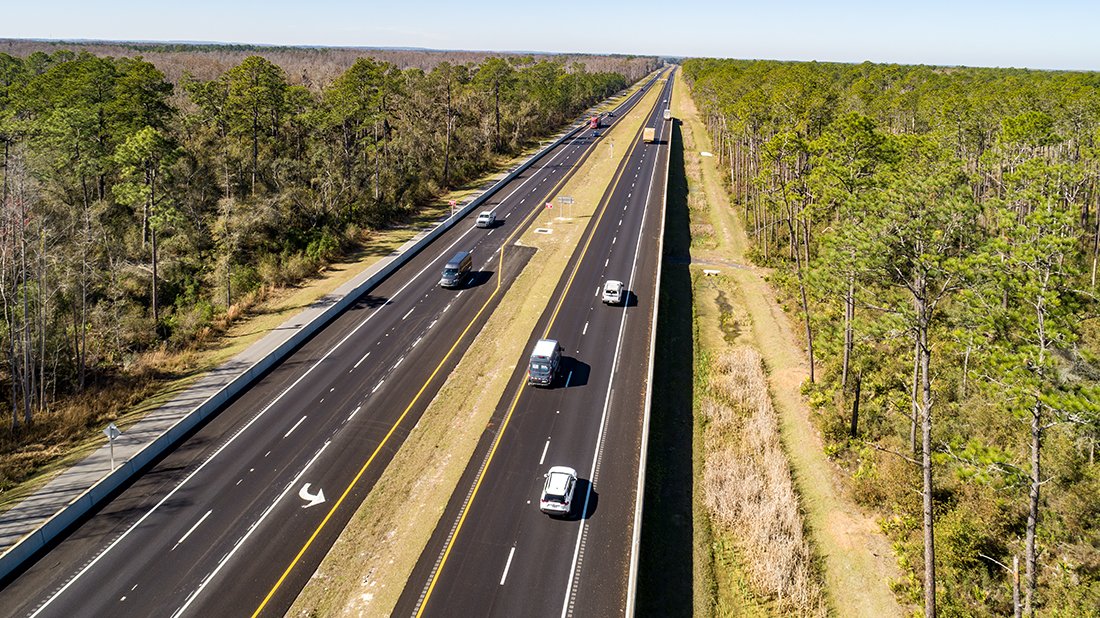
A 21-mile gap of Florida’s State Road (SR) 50 from US 301 to Groveland remained the highway’s last two-lane segment. Heavy truck traffic along this corridor had become a growing safety concern with drivers often trapped behind slow-moving trucks for miles. Frustration on the narrow roadway led some motorists to pass in no-passing zones, creating dangerous conditions and contributing to head-on collisions.
To address safety concerns, the Florida Department of Transportation (FDOT), with support from the Florida Legislature to accelerate the project timeline, advanced a $70 million project on the western end of the gap to widen an 8-mile stretch of SR 50 through the Withlacoochee State Forest in Sumter and Hernando counties. The project transformed the corridor into a four-lane, divided highway. FDOT selected DRMP as the prime design consultant under a single contract spanning FDOT districts five and seven. DRMP managed and delivered the two projects as a coordinated effort, overseeing all disciplines and ensuring consistency within district boundaries.
In FDOT District 7, DRMP provided services using all its disciplines including roadway and drainage design, signing and pavement markings, structural design, surveying, environmental permitting, maintenance of traffic, right-of-way coordination, and public involvement. For the FDOT District 5 segment, DRMP designed the bridges and led environmental permitting efforts while working closely with major subconsultant Kisinger, Campo & Associates (KCA), which delivered roadway design, drainage, and pavement marking services. Pevida Highway Designers, Dannick Engineering Services, and Tierra, Inc., provided engineering assistance while Geodata Consultants provided right-of-way (ROW) mapping and survey services on this project.
Engineering with Nature
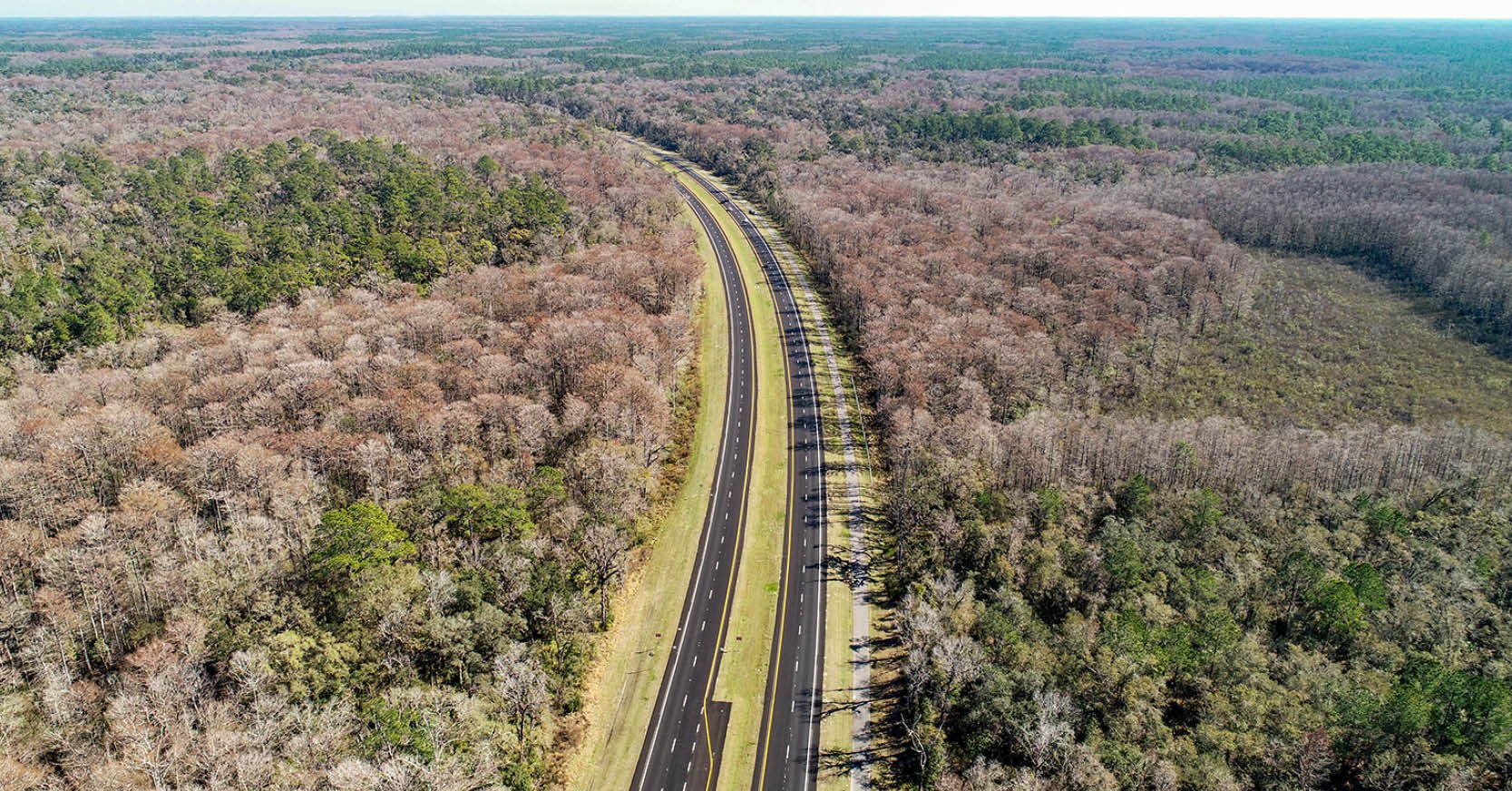
SR 50 is an east-west corridor that spans the state of Florida and connects the Gulf Coast to the Space Coast. While much of the roadway had already been widened to four lanes, this segment - from east of US 301 to east of CR 757 – through the Withlacoochee State Forest represented the final two-lane gap. The corridor passes through environmentally sensitive state lands that are home to Florida black bears, gopher tortoises, and numerous other protected animal and plant species, making this final widening effort especially complex.
Environmental coordination was one of the defining aspects of the project, requiring close collaboration with the Florida Forest Service (FFS), the Acquisition and Restoration Council (ARC), the U.S. Fish and Wildlife Service (FWS), the Southwest Florida Water Management District (SWFMD), the Florida Department of Environmental Protection (FDEP), the U.S. Forest Service (USFS), Audubon Society representatives, two FDOT districts, local governments, and utility providers. These commitments were documented during a prior Project Development & Environment (PD&E) study and carried out through final design.
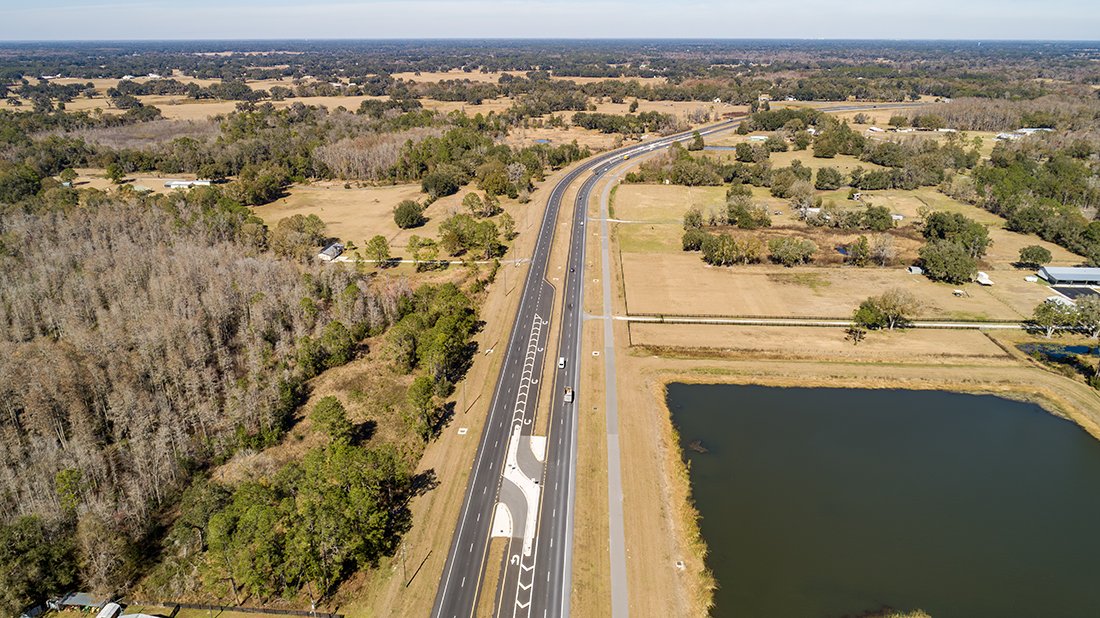
Working closely with the FFS, DRMP sought to minimize impacts to state lands wherever possible. Early concepts included multiple stormwater ponds within the forest, but DRMP refined the design to convey roadway runoff to treatment ponds located outside forest boundaries. This approach reduced land acquisition within the forest, minimized wetland impacts, and still met all stormwater and water quality requirements.
The Forestry Service agreed to minor increases in internal water levels, allowing the design team to eliminate several in-forest ponds and preserve sensitive habitats. Impacted state lands were replaced with multiple times the acreage, coordinating with the FFS and FDOT to acquire contiguous properties supporting the forest. DRMP also aligned a pedestrian underpass with a state multi-use trail, improving connectivity for wildlife and recreational users. Rather than installing large wildlife fences through the forest, DRMP incorporated oversized culverts to allow smaller wildlife to pass beneath the roadway and designed a larger wildlife underpass to safely funnel larger species. Additional wildlife enhancement features were integrated throughout the corridor in response to input from environmental stakeholders, which resulted in broad support for the final design.
Full-Service Engineering
Nearly every DRMP discipline contributed to the project. Survey services included topographic surveys of the mainline roadway, pond sites, and channel cross sections of the Little Withlacoochee River. DRMP managed survey coordination with subconsultants, supervised data processing and quality control, and oversaw scheduling and invoicing. Drainage design focused on reducing the footprint within state lands by strategically locating treatment facilities outside the forest and minimizing right-of-way impacts. Right-of-way parcels for treatment ponds outside the forest were acquired early, and runoff from the roadway within the forest was conveyed to these off-forest ponds, minimizing environmental impacts while meeting stormwater and water quality requirements.
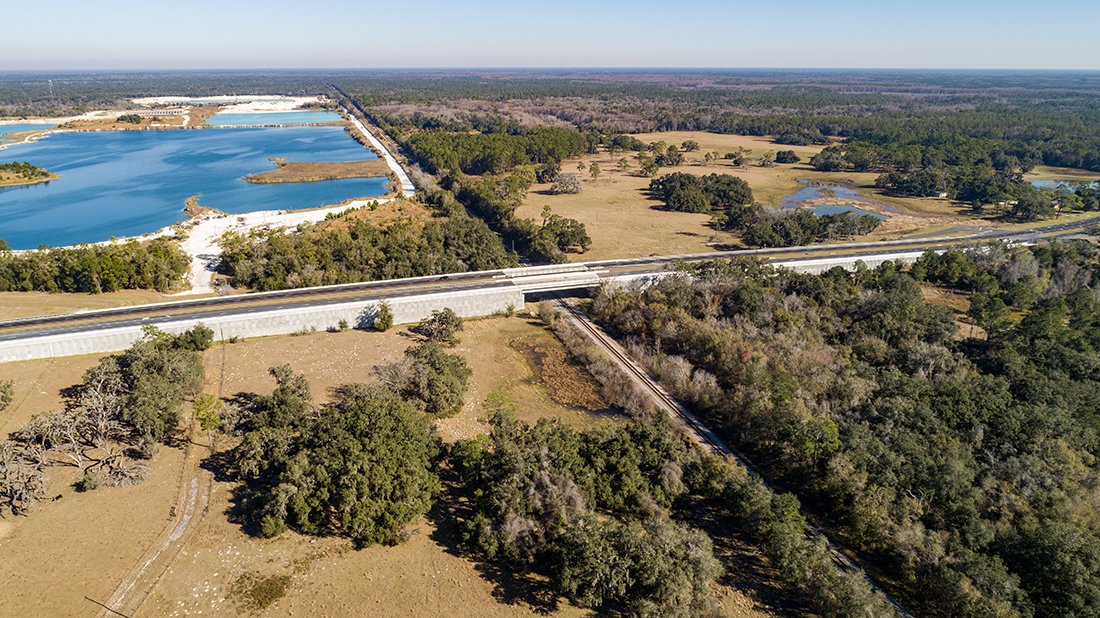
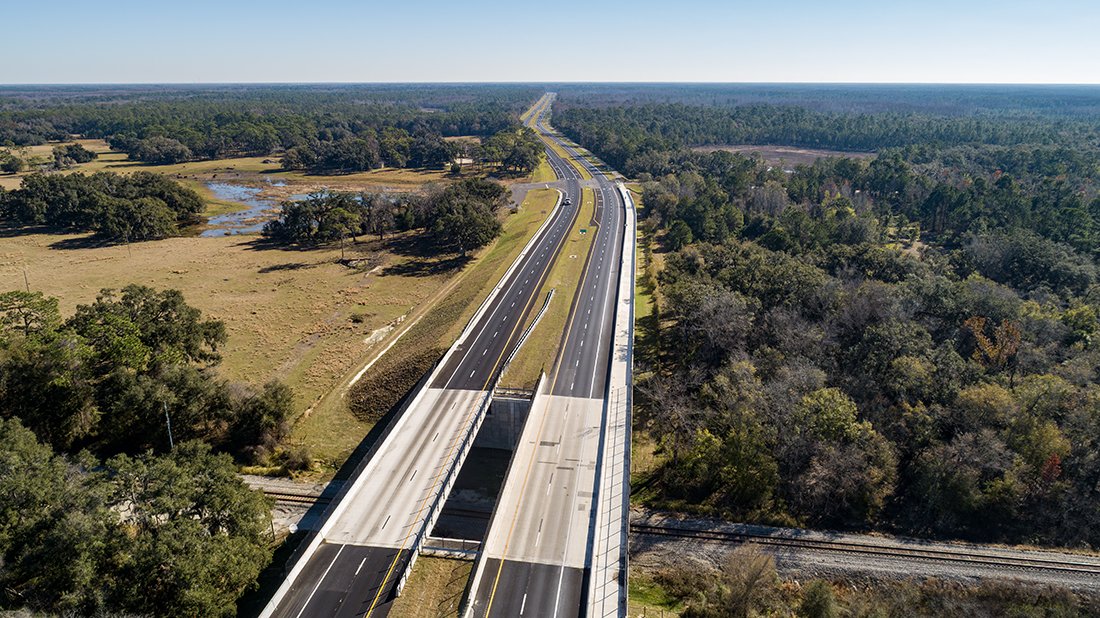
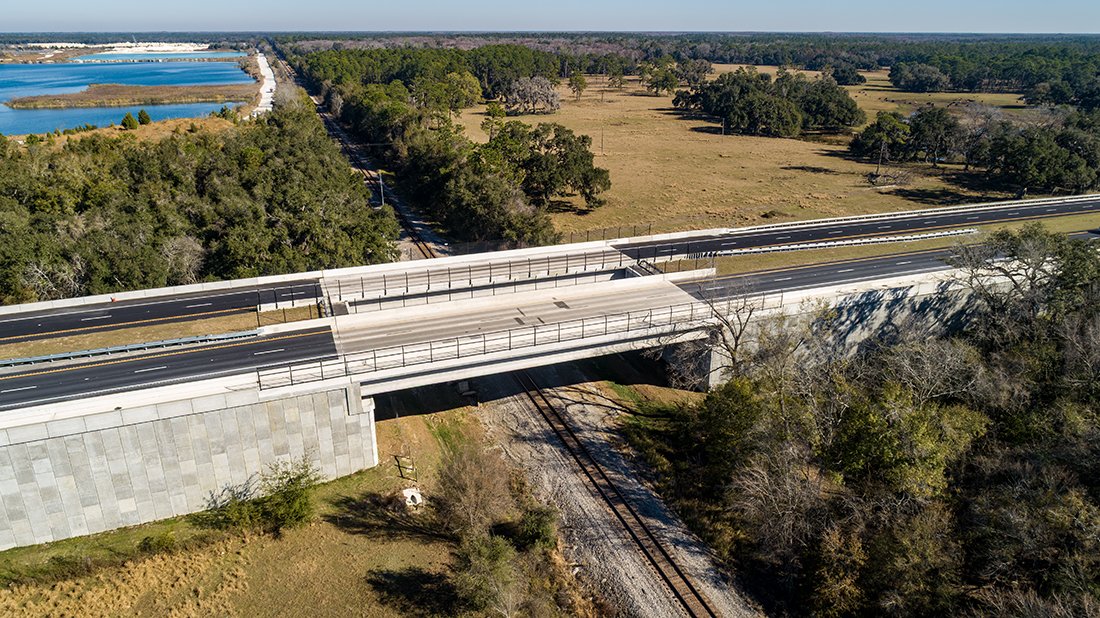
The project included multiple complex structural elements. DRMP designed and replaced a bridge over the Withlacoochee River using a five-span structure composed of AASHTO Type II beams founded on driven concrete piles, matching the configuration of the existing crossing. To improve safety and eliminate an at-grade rail crossing, DRMP also designed a bridge over the CSX railroad, spanning the full railroad right-of-way with a single span of Florida-I 63 beams and retaining walls at each end. This work required extensive coordination with CSX and a nearby mining operation.
Coordination and schedule management were among the project’s greatest challenges. The work spanned two FDOT districts, multiple regulatory agencies, and an accelerated timeline driven by legislative priorities to complete the final four-lane segment of SR 50.
Through advanced design, early identification of right-of-way needs, and close collaboration with FDOT and the ARC committee, DRMP helped compress the project schedule and save approximately a year in design time. Construction was completed and all four lanes through the forest opened in 2025. Early right-of-way acquisition, coordination with environmental agencies, and permitting efforts enabled FDOT to advance construction efficiently.
With construction completed and the corridor open to traffic, the SR 50 Widening project represents the final step in transforming SR 50 into a continuous four-lane corridor across Florida. The project significantly improves safety, mobility, and regional connectivity while demonstrating how sound engineering, strong partnerships, and legislative support can deliver infrastructure solutions that respect the traveling public and the surrounding natural environment.
Don Brown, PE, is a Vice President and Drainage Division Leader in DRMP’s Transportation Market Sector.